How much do OnlyFans agencies take? The math for creators who already earn
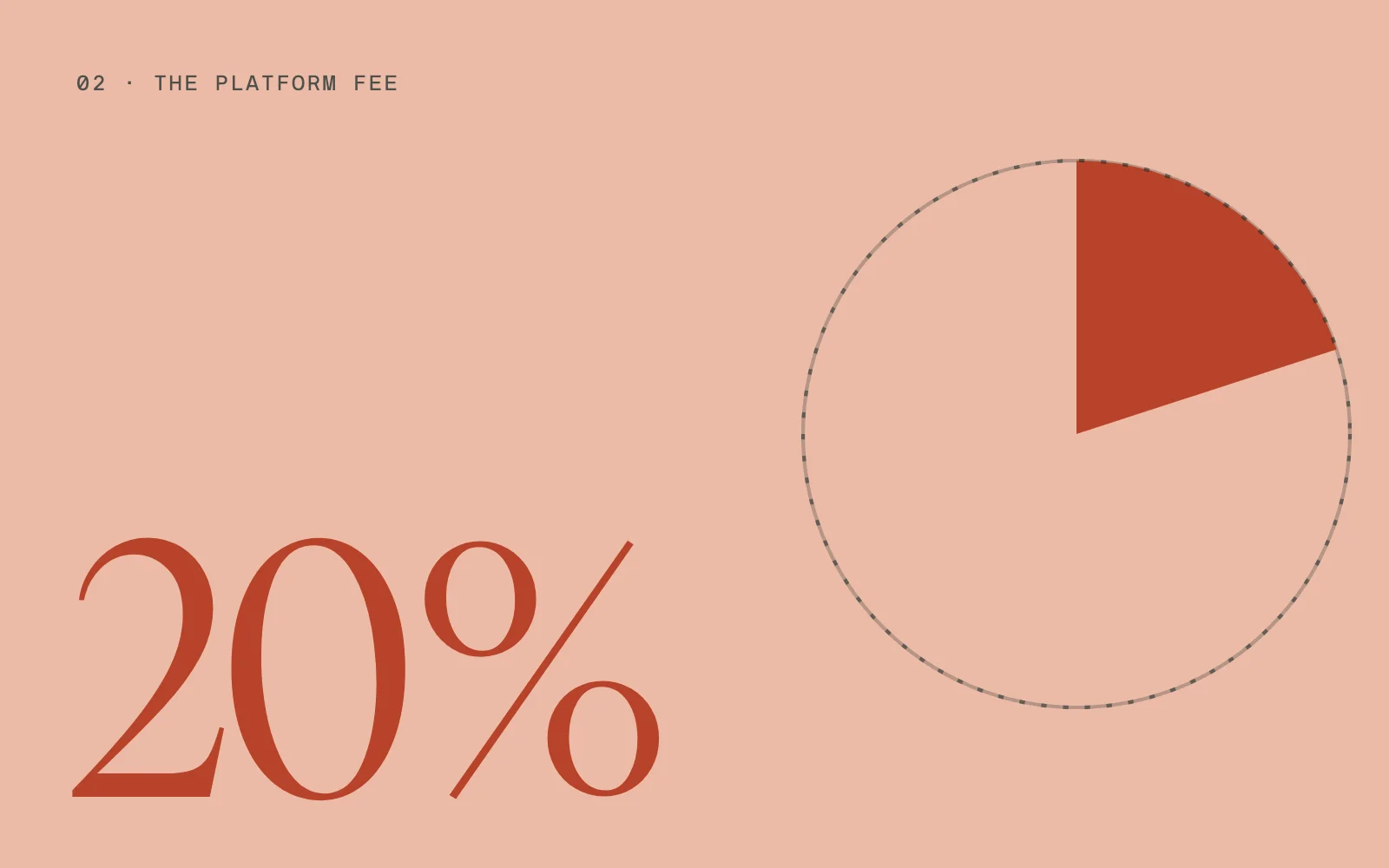
There is no official OnlyFans agency commission. OnlyFans takes 20% of every fan payment, and whatever an agency charges comes out of what's left. The percentage alone won't tell you what you keep: the base it's charged on, what counts as revenue and the costs outside the commission decide that. Here is the math on real numbers.
Key takeaways
- OnlyFans keeps 20% of every fan payment before any agency gets paid.
- OnlyFans doesn't set or endorse agency rates. A BBC investigation found UK contracts commonly around 50%, some as high as 70%.
- At an example rate of 50%, a net base leaves you 40% of fan spend and a gross base leaves you 30%.
- At 50% of net, the agency has to double your fan spend before you earn a dollar more than you do alone.
- Get the fee in dollars, on your own numbers, in writing.
What OnlyFans takes first
Every calculation starts with the platform. The OnlyFans Terms set its fee at 20% of each fan payment, deducted before the money reaches you. You keep 80%.
On a $20,000 month, that's $4,000 to OnlyFans and $16,000 to you. Any agency commission comes out of those $16,000, whatever the contract calls the base. Keep that in mind whenever a percentage sounds modest.
What's on record about agency rates
OnlyFans doesn't set agency rates, and it doesn't vouch for any agency. A spokesperson told Reuters, as quoted by Top Class Actions, that the platform isn't affiliated with and doesn't endorse any third party or agency. So there's no official benchmark to hold an offer against.
The clearest independent data point is journalism. A BBC investigation from June 2026, as reported by IBTimes UK, interviewed 60 UK creators and found contracts commonly around 50%, some as high as 70%, on top of the platform fee. That's a snapshot of one country's contracts, not a price list, and it can't tell you what's fair for your account.
What it does show is why the details matter. At those levels, the gap between a good contract and a bad one is thousands of dollars a month, and most of that gap sits in the definitions: the base, the revenue covered and the extra costs. So when someone tells you the standard is a particular number, don't argue about the number. Ask what the offer leaves you in dollars.
Gross or net: the word that moves thousands
Two contracts can both say 50% and leave you with very different money. On a net basis, the agency takes its share after OnlyFans' 20%. On a gross basis, it takes its share of the full amount fans paid, and you absorb the platform fee alone.
Neither base is a given, and a contract that only says "revenue" leaves the question open. Make it name the base in plain words. Here's the difference on a $20,000 month, where OnlyFans keeps $4,000 and $16,000 is left. The rates are examples chosen to show the mechanics, not market data. Percentages in brackets are your share of total fan spend.
| Example rate | Agency takes (net basis) | You keep (net basis) | Agency takes (gross basis) | You keep (gross basis) |
|---|---|---|---|---|
| 30% | $4,800 | $11,200 (56%) | $6,000 | $10,000 (50%) |
| 40% | $6,400 | $9,600 (48%) | $8,000 | $8,000 (40%) |
| 50% | $8,000 | $8,000 (40%) | $10,000 | $6,000 (30%) |
| 60% | $9,600 | $6,400 (32%) | $12,000 | $4,000 (20%) |
| 70% | $11,200 | $4,800 (24%) | $14,000 | $2,000 (10%) |
Combine the highest reported rate with a gross base and you keep $2,000 of a $20,000 month. That's the scenario to rule out in writing before anything else.
The break-even: how much growth pays for the cut
The real question isn't whether a cut is high. It's whether the agency grows the account enough that your share beats what you make alone. That's simple arithmetic.
On a net basis, divide 1 by (1 minus the rate). The result is how much your fan spend has to grow before you're even. Again, the rates are examples:
- 30% of net: 1 ÷ 0.7 = 1.43, so fan spend has to grow 43%
- 40% of net: 1 ÷ 0.6 = 1.67, so it has to grow 67%
- 50% of net: 1 ÷ 0.5 = 2, so it has to double
- 60% of net: 1 ÷ 0.4 = 2.5, so it has to grow 150%
On a gross basis it's steeper: 0.8 ÷ (0.8 minus the rate). At 50% of gross, that's 0.8 ÷ 0.3 = 2.67. Fan spend has to grow 167% before you're back where you started.
Here's what 50% of net means at three income levels:
- $10,000 a month in fan spend. You keep $8,000 alone. With the agency, you need $20,000 in fan spend to keep the same $8,000.
- $30,000 a month. You keep $24,000 alone. Break-even with the agency is $60,000.
- $100,000 a month. You keep $80,000 alone. Break-even is $200,000.
Everything above break-even is your gain. Below it, you're paying for management out of money you'd have made anyway.
Growth that sounds good can still lose you money. Say you're at $20,000 in fan spend, keeping $16,000 alone. An agency at 50% of net takes you to $30,000, a 50% jump. You now keep $30,000 × 0.8 × 0.5 = $12,000. The account grew and you earn $4,000 a month less.
One honest adjustment: time. If you spend 30 hours a week in the inbox and an agency takes that over, those hours have value. Put your own number on them before the call, not after, so they don't turn into a reason to accept a weak deal.
What the percentage doesn't show
A rate is one line in a contract. These are the lines that change what it really costs:
- What counts as revenue. Subscriptions, messages, tips, other platforms, brand deals. A commission on all creator income can reach money the agency never touched.
- Upfront fees. Setup, onboarding or strategy fees paid before any results. Treat them as a cost in their own right: ask what each one buys and whether it's refundable.
- Costs billed separately. Chatter wages, ad spend, content production. Each needs an amount or a cap in writing.
- Commission after you leave. A contract can keep paying the agency after termination, on subscribers it brought in or for a fixed period. If yours does, it needs an end date and a formula you can calculate yourself.
- Who receives the money. The BBC reporting describes managers holding payment tools. If payouts land with the agency and it forwards your share, you're trusting its accounting every month.
How to compare two offers
- Send each agency the same baseline: three months of fan spend and your revenue mix.
- Ask for the rate, the base, every other cost and the exit terms in writing. A pitch deck isn't a contract.
- Ask each to show what you'd keep in dollars on last month's numbers with zero growth. That's your worst case.
- Ask what they'd change first and where the growth comes from: chat, traffic or pricing. A plan beats a promise.
- Compare what you'd keep at zero growth, at their projected growth and at half of it.
The lower rate doesn't always win. Take two hypothetical offers on $20,000 of fan spend, both on a net basis. A 30% agency that adds 20% brings you to $24,000; you keep $24,000 × 0.8 × 0.7 = $13,440. A 50% agency that doubles the account brings you to $40,000; you keep $40,000 × 0.8 × 0.5 = $16,000.
But only if the doubling happens. That's why the exit clause matters as much as the rate.
Propose a structure that pays for growth
You don't have to accept the structure you're offered. One option to put on the table: commission only on what the agency adds above your baseline. At $20,000 in fan spend, your baseline is $16,000 after the platform fee. If the agency takes you to $40,000, net is $32,000, the growth above baseline is $16,000, and 50% of that is $8,000. You keep $24,000 instead of the $16,000 you'd keep under 50% of everything. An agency confident in its growth plan should at least discuss it.
Also ask whether commission is calculated on earnings or on payouts, and what happens with refunds. Small definitions like these decide what shows up on the invoice.
For the other clauses, see the OnlyFans agency contract checklist, and the full vetting list in how to choose an OnlyFans agency.
How CreatorsHub handles the money
- You get paid first. Payouts go from OnlyFans straight to your bank account. We send an invoice after the money is yours, never the other way around.
- $0 upfront.
- The split in writing. At the strategy call you get the roadmap, the numbers and the split, everything in writing before you decide.
For reference: Paula went from $2,200 to $150,000 a month and crossed $150,000 in month twelve. Isabella's case: $68,930 a month. Sophie's: $88,982 in one month. The cases are on results, and what we do for the fee is on services.
To see the math on your own account, apply for a free audit: three screenshots, two minutes, no account access.
FAQ
How much do OnlyFans agencies take?
There is no official rate. A BBC investigation, reported by IBTimes UK, found UK contracts commonly around 50% and some as high as 70%, on top of the 20% OnlyFans fee. What you keep depends on the base and the other costs in the contract.
Is agency commission taken from gross or net earnings?
It depends on the contract, so make it name the base. On a $20,000 month, 50% of net leaves you $8,000 and 50% of gross leaves you $6,000.
How much does an agency need to grow my account to be worth it?
On a net basis, divide 1 by 1 minus the rate. At 50% of net, your fan spend has to double before you earn more than you do alone.
Are there costs besides the commission?
Often: upfront fees, chatter wages, ad spend and commission that continues after you leave. Ask for every cost in writing before you sign.
Sources
- OnlyFans — Terms of Service
- IBTimes UK — Report on the BBC investigation into OnlyFans agents
- Top Class Actions — OnlyFans class action over chatters impersonating creators
Last updated